
The More You Know: Moose Antlers Come With Fine Print
- Aug 13
- 2 min read

There are some things you learn because you go looking for the answer.
And then there are things you learn because someone asks a question and you suddenly realize you have absolutely no idea.
This was one of those.
I was at a wildlife presentation not too long ago when someone asked whether it was legal to collect a moose antler shed.
The presenter didn't have an answer.
And I realized, neither did I.
Which was mildly inconvenient, considering I had already collected a few.
I had never really considered that moose sheds might be treated differently from whitetail sheds. I had found them while documenting Wisconsin's moose, reported the finds to the Wisconsin DNR, and eventually started using some of them as educational specimens during presentations.

But now someone had asked the question.
So naturally, I went home and started reading.
I found Wisconsin Administrative Code NR 45.04(1s)(a)5, which addresses the collection of shed antlers, clean skulls, and clean bones of certain wild animals for which an open season has been established.
I had to pause.
Rewind.
Reread.
There is no open season for moose in Wisconsin.
Well, then.
Moose antlers, as it turns out, are not the same as whitetail sheds.
So I did what seemed like the obvious thing: I reached out to the Wisconsin DNR and asked.
The answer was an education permit for the antler finds I have collected, allowing them to continue being used for education and outreach.
Which is good, because these antlers have already had a fairly busy second life.
They have been held by people who have never seen a moose in Wisconsin.
They have been passed around during presentations while I explain how large these animals actually are.
They have helped make a rather elusive animal a little more tangible.
And now they are properly permitted to keep doing it.

The More You Know
One of the things I have learned through this project is that documenting wildlife is rarely as straightforward as it sounds.
You see a moose.
You photograph the moose.
You record where and when you saw the moose.
Simple enough.
Until someone asks a question.
Then you discover there is another layer.
That has happened more times than I can count.
A photograph turns into a question about individual identification.
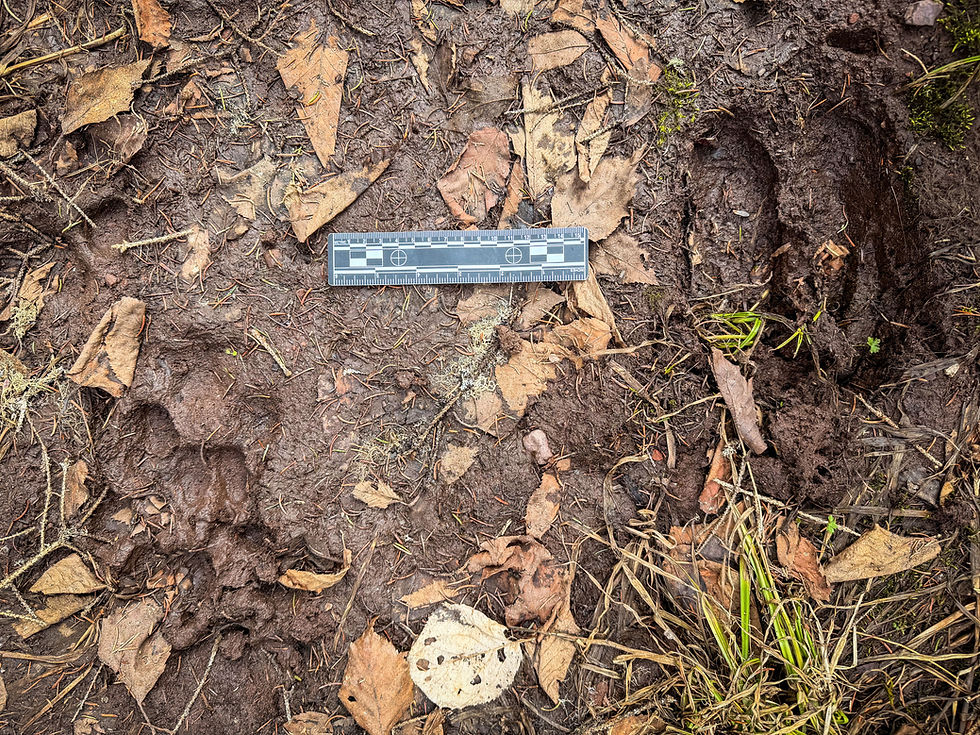
A track turns into a question about habitat use.
A calf turns into a question about residency.
And apparently, an antler turns into a question about wildlife regulations.
So, after nearly a decade of documenting Wisconsin's moose, I have added another item to the list of things I know to double-check.
Moose sheds are not whitetail sheds.
The more you know.


Comments