

Meet Pancho
The One-Antlered Bull Who Helped Tell Wisconsin's Moose Story
Some moose become recognizable because of where they live.
Pancho became recognizable because he refused to fit the pattern.
Over the years, this remarkable bull has become the most frequently documented individual in the Hidden Moose of Wisconsin study. His distinctive antlers, curious behavior, and repeated appearances have provided a rare opportunity to follow a single wild moose across multiple years, offering valuable insight into the life of one of Wisconsin's most elusive mammals.
Before There Was Pancho
Pancho wasn't always Pancho.
The first known observation of what would later become known as Pancho occurred in June 2017, when someone reported seeing a bull moose with only one antler in far northern Wisconsin. There was no photograph, just an unusual observation.
A month later, another report came in. Then another.
The sightings followed a similar pattern. Witnesses described a bull that appeared to have already dropped one antler during summer, well before the normal antler shedding season.
A bull dropping an antler in July isn't impossible. Antlers can occasionally be broken or damaged during their growth. But as more reports accumulated, the explanation became harder to accept.
Was this simply coincidence...or were people seeing the same animal?

Later that year, Jane Ludka Villeneuve photographed a young bull moose in Iron County and shared the image in the comments of a Wisconsin DNR Facebook post about moose in Wisconsin. At the time, it was simply another remarkable moose sighting.
The photograph remained unknown to the Hidden Moose of Wisconsin study until October 2024, when a search through historical public observations uncovered the image. By then, the one-antlered bull had already become well known through years of field research. His distinctive antler configuration, a fully developed left antler paired with a small, permanent right-side nub, made it immediately clear that the young bull in the 2017 photograph was Pancho.
Nearly than a decade later, the exact cause of his unusual antler development remains unknown.
Based on the development of his left antler, Pancho is estimated to have been approximately two years old in that first photograph, suggesting he was likely born in 2015.

The Photograph That Changed Everything
Although the 2017 photograph would eventually become Pancho's earliest known record, it wasn't until November 5, 2020, that he first became a recognizable individual in the Hidden Moose of Wisconsin study.
For several years, reports of a bull moose with only one visible antler continued to accumulate across seasons. Many observers reported that they believed he had broken or shed the other antler.
Then, on November 5, 2020, one photograph changed everything.
One of the Hidden Moose of Wisconsin trail cameras, which also participated in the Wisconsin DNR's Snapshot Wisconsin program, captured a bull moose investigating the camera housing. Rather than simply walking past, he decided the protective bear box made an excellent scratching post, triggering approximately sixty photographs, many from only inches away.
Most of those images featured little more than an extremely close view of the back half of a moose.
One image, however, told an entirely different story.

It clearly showed that the right antler was not broken or recently shed. Instead, the image revealed a small antler growing from the right pedicle, dramatically different in size and structure from the fully developed left antler.
Suddenly, years of scattered observations began to fit together.
The reports of a bull that had "already dropped an antler" were not describing multiple animals.
They were describing one.


Becoming Pancho
Once it became clear that the same bull was being documented again and again, he needed a name.
Many people naturally started calling him "Lefty."
It fit his appearance, but somehow it never fit the moose.
Whenever "Lefty" came up in conversation, I'd joke, "Wrong bandit. This one's Pancho," a nod to the Townes Van Zandt song Pancho and Lefty.
Somewhere along the way, the joke stopped being a joke.
The name stuck.
Today, everyone knows him simply as Pancho.
The Long Silence
Not every chapter of Pancho's story has been easy.
After being photographed on March 17, 2024, Pancho disappeared from every project camera.
Days turned into weeks.
Weeks became months.
Eventually, the absence stretched to 601 days.
For anyone who follows individual wildlife over many years, long periods without evidence leave difficult questions.
Had he shifted his home range?
Had something happened?
Would he ever be seen again?
Then, on November 8, 2025, a notification appeared from one of the project's cellular trail cameras.
There, standing perfectly centered in the frame, was Pancho.
Not at the edge of the photograph.
Not partially hidden behind brush.
Perfectly centered, staring into the camera.
It almost felt like he was saying,
"Hey...it's me. I'm back."

Later camera checks revealed that he had actually passed two additional project cameras before reaching the cellular camera, shortening his documented absence to 543 days.
Still, for those 601 days, there had been no way to know what had become of him.
Sometimes wildlife reminds us that there is a difference between not being seen and not being there.


More Than a Distinctive Antler
Pancho's unusual appearance may be what makes him recognizable.
His personality is what makes him memorable.
Most moose pass through a trail camera's field of view in just a few seconds.
Pancho often stays.
Over the years, he has repeatedly lingered around project cameras, browsing nearby vegetation, bedding down for naps, investigating the equipment, and occasionally using the protective bear boxes as scratching posts
On more than one occasion, he has walked directly up to a camera to inspect it with his nose.
On another, he spent enough time scratching against a bear box to trigger sixty photographs.

Pancho browsing nearby vegetation
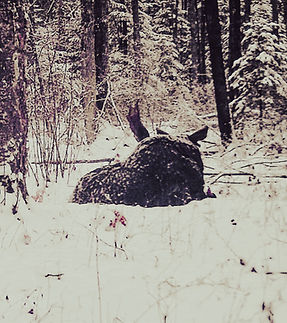
Pancho bedded down

Pancho inspecting the camera

Pancho using a trail camera as a scratching post


And yes...Pancho has also developed a habit of leaving the camera with an excellent view of his backside instead of his face. More than one "Pancho mooning the camera" photograph exists in the collection.
Whether by coincidence or preference, Pancho has chosen to rest in front of project cameras on four separate occasions across three different camera locations. While most moose quietly move through the frame, Pancho often seems perfectly content to stay awhile.
One of those naps ended rather abruptly in November 2022 when another bull, Sebastian, wandered into the frame.

Pancho getting up from a resting position

Pancho turning toward sound off-camera

Sebastian entering the frame

Pancho and Sebastian facing off
The opening moments of the encounter were captured perfectly in front of the camera. As the sparring match unfolded, however, the bulls drifted just beyond the frame. Camera triggers continued for more than 20 minutes, suggesting the contest carried on largely out of view, with only the occasional leg or shoulder appearing at the edge of an image. A separate trail camera later captured Sebastian leaving the area.
Despite carrying only one fully developed antler, Pancho more than held his own.

Sebastian leaving the area, captured on a second camera
Today, Pancho has been documented in more than 23 project observation records and approximately 400 photographs, making him one of the best-documented individual moose in the Hidden Moose of Wisconsin study.
Project field work has also led to the recovery of two of Pancho's shed left antlers. His small right-side nubs, however, remain as elusive as Pancho himself. Pancho's 2023 left antler, discovered in April 2024, inspired the antler featured in the Hidden Moose of Wisconsin logo, a tribute to the bull who has become one of the defining individuals in the study.

Why Pancho Matters
Pancho is more than a recognizable moose.
He demonstrates the value of long-term field research.
Without years of patient observation, scattered reports of a one-antlered bull would have remained just that: scattered reports.
Instead, they became the documented life history of a single wild moose.
Pancho reminds us that every observation has the potential to become part of a much larger story. Sometimes the most important discoveries don't happen in a single day. They emerge slowly, one photograph, one trail camera visit, and one season at a time.
