
September: Moose Month, Rut Season & an Extraordinary Forest

Those who have been following Hidden Moose of Wisconsin for a while probably know that I have unofficially declared September Moose Month each year.
How does one make that official? I have no idea. There is apparently no governing body for such things. So for now, I remain the sole member of the September Moose Month Commission.
But there is good reason for the annual proclamation. September is the busiest month for moose in Wisconsin, at least according to our data. Of all the moose observations recorded by Hidden Moose of Wisconsin, 37.18% have occurred in September.
And 2026 has been particularly moosey. Through the end of September, 50% of all HMW recorded observations recorded so far this year occurred in September. Half. In one month.
So yes, September did not disappoint.
Moose were out doing their moosey thing, and I was fortunate to document and hear about quite a few of them. Most of the observations were bulls, which isn't particularly surprising this time of year. September is rut season, after all, and the boys have places to go, cows to find, and occasionally some very muddy business to attend to.

A big thank you to the entire Hidden Herd, all of the Hidden Moose Observation Network members, and all of the community members who shared their moose observations with me this month. I love hearing the excitement that comes with encountering a Wisconsin moose, whether it is your first one or your tenth. Every observation matters, and every story adds another little piece to the much larger puzzle we're trying to understand.
So if you happen to see a moose out there, please tell me about it! Send your observation, photo or story to Hidden Moose of Wisconsin. You never know which seemingly simple sighting might become an important piece of the puzzle.

A Little Nerdy Moose Data
Since this is Hidden Moose of Wisconsin, let's take a quick detour into the data.
When we evaluate our observations for moose residency, we do not factor bull observations during the peak of the rut into those determinations. Bull behavior during this period is strongly influenced by the breeding season. They may travel considerably farther than they would at other times of year, so a September bull sighting isn't necessarily a good indicator of where that individual spends the rest of its year.
And that's just one of the considerations that goes into our residency calculations, or, in this case, doesn't go into them. There are a few other types of observations and circumstances that we leave out as well, but we won't bore you too much with the finer points of the methodology in this particular blog.
There is only so much nerdy moose data we can unleash at once. We'll save some of the fun for another day.
So, back to September bulls: they are excellent moose observations. They are just not necessarily excellent residency evidence.
A cow during this same time of year, however, is a different story. Her behavior during the rut can provide a more meaningful piece of the residency puzzle, particularly when an observation fits with other evidence showing repeated use of an area.
And then there are the rut pits.
For those who don't follow Hidden Moose of Wisconsin on social media, I also found several active rut pits this September.
One find was particularly satisfying. I found the pit, documented it, placed a camera on it, and immediately began wondering just how fresh it was. It certainly looked fresh. Then I checked the camera in the area and found the answer: our one-antlered wonder had passed through just 14 hours earlier.


So, yes. That was a fresh rut pit.
Another rut pit announced itself in an entirely different way. I discovered it by smell.
Let's just say it was sun-baked and leave it at that.

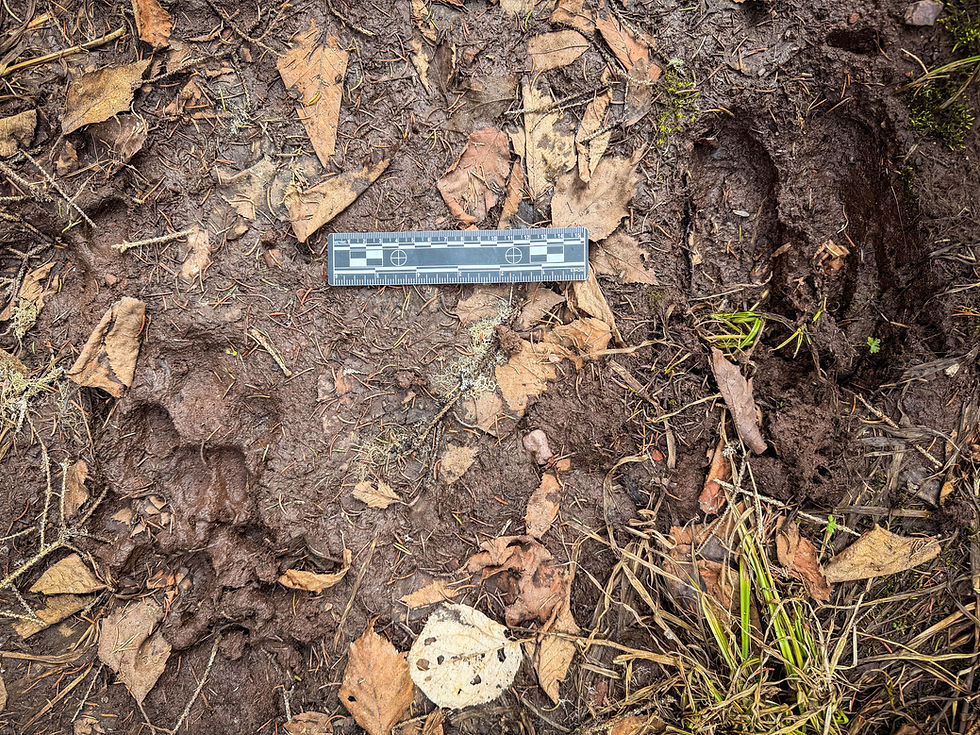
These are the sorts of little discoveries that make field work so much fun. Sometimes the moose is standing right in front of you. Sometimes the evidence is a muddy depression, a rubbed tree, a track or some other small clue that says, I was here.
And sometimes the forest tells you exactly who has been there without actually showing you the moose.
An Extraordinary Forest
September also brought an entirely different kind of field experience.
I was exceptionally fortunate to receive a tour of a truly remarkable property with caretaker Rod Sharka, who knows the land well and has a deep connection to it.

The property is Tenderfoot Forest Reserve, owned by The Nature Conservancy, and I fell for it almost immediately.
There were yellow birch trees larger than any I have ever seen. Old-growth maple, birch and hemlock. Massive trees rising from a forest floor that felt wonderfully, gloriously old.

Tenderfoot is part of the larger Border Lakes Area, a network of public and private forest lands encompassing roughly 24,000 acres in Vilas County. The reserve protects nearly four miles of undeveloped shoreline along Tenderfoot, Roach, Sanborn and Mirror Lakes, along with wetlands, spring-fed ponds, wild lakes and streams.
And then there are the trees.
Some of the white pines in the Border Lakes Area are estimated to be up to 400 years old.
Four hundred years.

Standing among trees that were already growing before Wisconsin was Wisconsin is a humbling experience. It makes you feel very temporary in the best possible way.

The forest is also part of something much bigger than the trees themselves. The Tenderfoot property contributes surface water and groundwater to the Presque Isle and Ontonagon River watersheds, whose watersheds together cover more than 1.25 million acres across Wisconsin and Michigan.
This is the sort of place that makes you slow down.
Not because you are trying to find a moose.
Not because you are collecting miles or checking a box.
Just because the forest has something to say if you are willing to stand still long enough to listen.

And perhaps that is part of what makes places like Tenderfoot so important. Understanding Wisconsin's moose means paying attention to more than the moose themselves. The forests, wetlands, lakes, landscapes and seasonal behaviors all help tell the story of the animals we're trying to understand.
The rut is happening. The forests are changing. The moose are moving.
And there are still a lot of pieces to this puzzle.
I'm very happy to keep wandering around looking for them.
Stay curious. Stay moosey.

Comments